
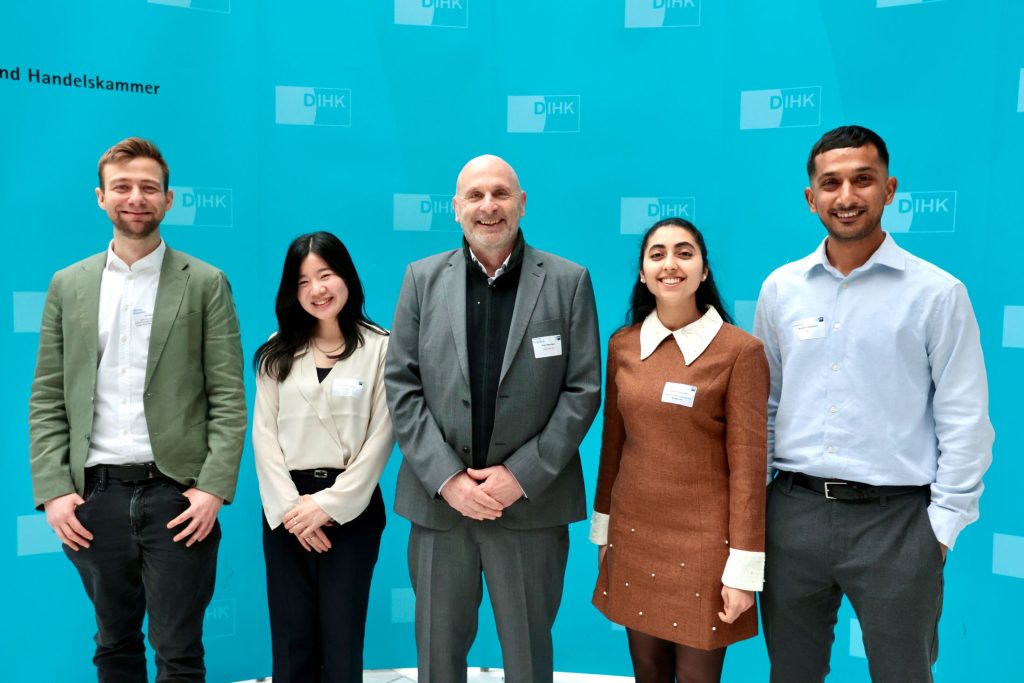
Photo: Jan Weiten, Morimi Tokuyama, Prof. Dr. Peter Heck, Meriem Drissi Sbai und Bhushan Chaudhary
The SAREP-Team of the Institute for Applied Material Flow Management participated on April 14 in a high-level event hosted by the German Chamber of Commerce and Industry, focusing on key challenges and solution pathways in current climate and energy policy.
The conference highlighted the growing pressure on businesses and policymakers to reconcile ambitious climate targets with economic stability. Discussions emphasized that technological innovation, efficiency improvements, and intelligent system integration are key levers for transformation. Particular attention was given to the development of grid infrastructure, which plays a crucial role in ensuring system stability and flexibility in the context of expanding renewable energy (RE).
In addition, the challenges of the European emissions trading framework in its current form (European Union Emissions Trading System 1, EU ETS 1) and the expected impacts of its extension to further sectors (EU ETS 2) on industry were discussed. Key issues included rising CO₂ prices, international competitiveness, and the associated transformation pressure. Furthermore, the role of international cooperation mechanisms under Article 6 of the Paris Agreement was addressed, particularly regarding their potential contribution to the decarbonization strategies of Europe and Germany.
Prof. Dr. Peter Heck participated in the closing panel entitled “How do we get out of the deadlock?”, where concrete solution approaches were discussed. He presented the SAREP project as an innovative example that combines climate protection with social and economic development in the African context. At the same time, the project offers Germany the opportunity to compensate for technically and economically unavoidable residual emissions through high-quality international projects, thereby contributing further to achieving climate targets.
IfaS would like to thank the German Chamber of Commerce and Industry for hosting this successful event and for facilitating a constructive exchange among representatives from business, policy, and academia.