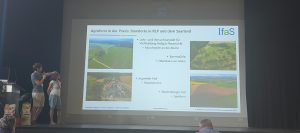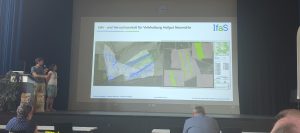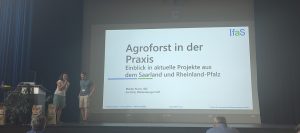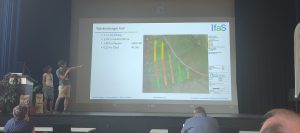
On 23rd June, IfaS project manager Martin Pesch and farm manager Ina Dörr from the Wackenberger Hof showed how agroforestry contributes to natural climate protection in the region as part of the 3rd conference on ‘Natural Climate Protection in Saarland and Rhineland-Palatinate’.
The two speakers focused on providing the local authority representatives in the audience with practical examples and tools to help them implement agroforestry in the two federal states of Saarland and Rhineland-Palatinate.
During the presentation, the Wackenberger Hof acted as an example of an agroforestry system already in place in the Saarland. The site, which is supported by the AFaktive project (a sibling project of AGROfloW), was planted in April this year. This article provides further details on the initial situation, which comprised erosion problems, and on the solution offered by the agroforestry system.
Although agroforestry is already recognised and practised (see IfaS projects such as the agroforestry system in the Wurzener Land region) and has long been acknowledged in the literature (see the Thünen Institute’s new study on soil carbon sequestration), this form of multifunctional land use and its benefits are not yet widely known. In line with the IfaS approach, stakeholders such as local authorities and districts must be actively involved, as they are not only key actors for successful implementation but also stand to benefit significantly from climate-resilient landscapes and the ecosystem services they provide. Furthermore, agroforestry can contribute to a range of local policy objectives, including sustainable heat supply, regional economic development, and climate adaptation.
Fittingly, the conference took place during a heatwave: the urgency of climate change adaptation was immediately apparent to all participants.