
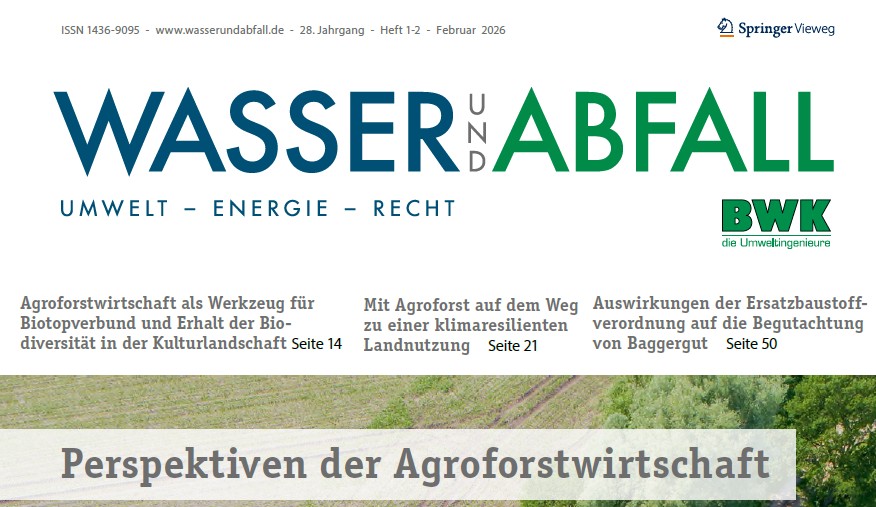
As a multifunctional land use form, agroforestry offers a range of benefits, from yields stabilisation to climate adaptation and increased biodiversity. In an article for the professional journal WASSER UND ABFALL (Water and Waste) published by the Association of Engineers for Water Management, Waste Management and Land Improvement Engineering (Bund der Ingenieure für Wasserwirtschaft, Abfallwirtschaft und Kulturbau, BWK), the Institute for Applied Material Flow Management, IfaS (Trier University of Applied Sciences), in collaboration with Geisenheim University, describes the connection between structurally complex forms of land use such as agroforestry and biodiversity conservation.
The article insights are based on past and ongoing projects such as FNR MODEMA, FNR AGROfloW and EU LIFE AFaktive, which also offer best practice examples for scaling agroforestry systems.
The authors consider agroforestry in the context of further developing land use by combining agriculture with other land function and services, such as watershed protection and biotope connectivity, which gives way to a ‘living cultural landscape development’ approach. Especially in light of climate change, agroforestry systems provide interesting ecosystem services for relatively modest financial outlays. Greater structural diversity in the landscape – through trees and shrubs – means greater biodiversity, as woody structures serve, for example, as habitats or biotope corridors.
Should this (still) niche land use form become more widespread in agricultural practice – ideally through a collaborative approach for local value chains (energy wood, fruit, nuts, etc.) – agroforestry could contribute significantly to fulfilling biodiversity and watershed protection requirements.
Article for the professional journal WASSER UND ABFALL (German version only)