
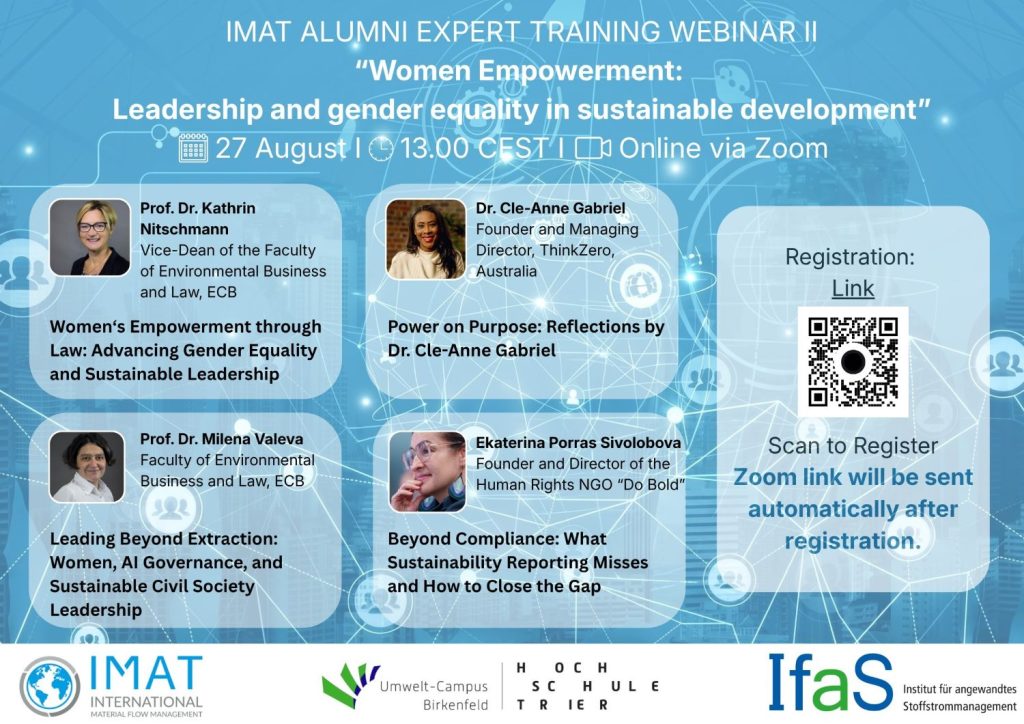
On August 27, the second IMAT Alumni Expert Training Webinar of the English-language Master’s programme in International Material Flow Management (IMAT) at Birkenfeld Environmental Campus was held online. Entitled “Women Empowerment: Leadership and Gender Equality in Sustainable Development,” the event focused on the role of women in leadership positions, the importance of gender equality, and the contribution that diverse perspectives can make to sustainable development.
The webinar brought together four inspiring female experts from academia, business, and civil society, offering participants international perspectives on leadership, sustainability, and social responsibility.
The webinar opened with Prof. Dr. Milena Valeva from the Department of Environmental Business and Environmental Law at Birkenfeld Environmental Campus. In her presentation, “Leading Beyond Extraction: Women, AI Governance, and Sustainable Civil Society Leadership,” she explored the role of women in shaping sustainable societies. In particular, she examined the interconnections between leadership, responsible artificial intelligence governance, and the importance of a strong civil society.
This was followed by a presentation from Prof. Dr. Kathrin Nitschmann, Vice Dean of the Department of Environmental Business and Environmental Law. Her contribution, “Women’s Empowerment through Law: Advancing Gender Equality and Sustainable Leadership,” highlighted the importance of legal frameworks in promoting gender equality and sustainable leadership.
An international perspective was provided by Dr. Cle-Anne Gabriel, founder and Managing Director of ThinkZero in Australia and an IMAT alumna. In her presentation, “Power on Purpose: Reflections by Dr. Cle-Anne Gabriel,” she shared her experiences and reflections on purpose-driven leadership, exploring the connection between personal responsibility, purpose, and sustainable action.
The webinar concluded with Ekaterina Porras Sivolobova, founder and director of the human rights NGO “Do Bold” and an IMAT alumna. In her presentation, “Beyond Compliance: What Sustainability Reporting Misses and How to Close the Gap,” she critically examined the limitations of sustainability reporting. Her contribution focused in particular on how companies and organisations can move beyond merely fulfilling formal requirements and instead implement sustainability and social responsibility in a meaningful and effective way.
The diverse contributions demonstrated that sustainable development encompasses far more than technological or economic innovation. Gender equality, responsible leadership, appropriate legal frameworks, civic engagement, and responsible governance of emerging technologies are all essential building blocks for a sustainable future.
The event is part of the DAAD-funded project “Global IMAT-Alumni Network 2.0: Expert Training for Sustainable Development.” Through the IMAT Alumni Expert Training series, the programme promotes exchange between current students, alumni, and experts from a wide range of academic and professional fields. The series complements academic education with practical insights and addresses current issues of major importance for the sustainable transformation of business and society.
The second IMAT Alumni Expert Training Webinar once again highlighted the international, interdisciplinary, and practice-oriented character of the IMAT programme. Bringing together perspectives from academia, business, and civil society demonstrated how important women’s empowerment and an inclusive leadership culture are for sustainable development.
The webinar was organised by Julia Veckes, Project Manager of the IMAT programme. With this event, the IMAT programme continues to contribute to the international networking of its students and alumni and to knowledge transfer between higher education, professional practice, and society.
The IMAT programme would like to thank all four speakers for their inspiring contributions, as well as all participants for the engaging and constructive exchange.