
On 10 August 2026, representatives from the Westerwald-Osteifel Rural Services Centre (DLR WW-OE) in Rhineland-Palatinate, the Supervisory and Service Directorate (ADD) of Rhineland-Palatinate, the Institute for Technology Transfer (FITT) at HTW Saar and the Institute for Applied Material Flow Management (IfaS) at Trier University of Applied Sciences came together for a joint workshop. The event, which was part of the capacity-building activities within the EU LIFE project AFaktive – coordinated by the IfaS – focused on how existing land consolidation tools can be utilised and further developed in future to support climate-adapted land management.
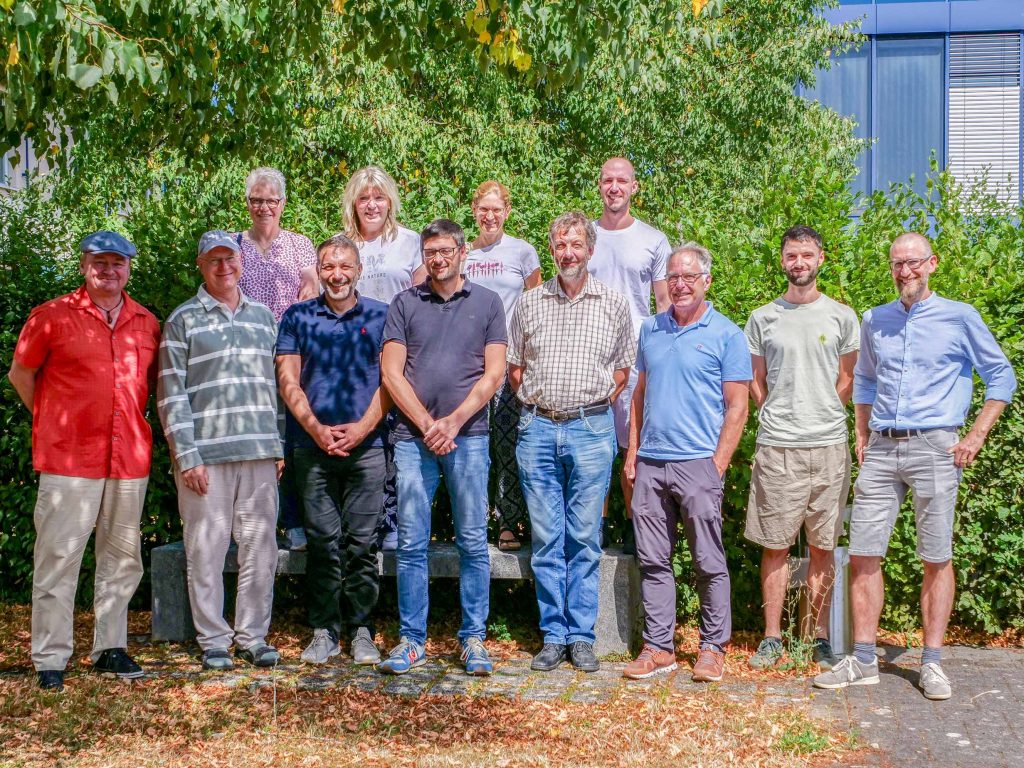
Land consolidation improves the agricultural structure and creates the spatial conditions for sustainable agricultural use in the long term. In view of increasing incidents of heavy rainfall, prolonged dry spells and rising erosion risks, water retention, soil protection and climate resilience are also to be incorporated more closely into planning in future. This is where the collaboration between the DLR WW-OE, the ADD, the FITT and the IfaS comes into play.
The workshop focused on a planned pilot project to test new planning and modelling tools. Five key areas of work were elaborated:
- Identification of the data required to record and model the current state
- Modelling of the target state to assess the impact of measures and enable early adjustments to the planning
- Development of tools to improve water retention on agricultural land and within the pathway and watercourse network
- Multifunctional design and use of landscape conservation areas, main drainage basins and wooded vegetation structures
- Investigation of agroforestry systems with regard to water retention, erosion control and biomass provision
The results of the pilot project are to be incorporated directly into the further planning of the land consolidation process under consideration. This will bring together the planning and procedural expertise of DLR WW-OE with FITT’s expertise in modelling and IfaS’s expertise in the areas of water retention, agroforestry, material flow management and multifunctional land use.
In the long term, the findings are to be incorporated into practical recommendations and a transferable guide for further land consolidation procedures.